SPATIAL MODEL
The Warehouse Digital Twin:
A Live 3D Model of Your Facility.
Most warehouse management systems treat a facility as flat text in a database — rows, aisles, bin codes on a spreadsheet. Spatialis OS starts from a different premise: build a live, millimetre-accurate 3D model of the building itself, with every bin, shelf, rack, beam, and aisle mapped in true X, Y, Z space. That model — the Dynamic Spatial Model — is what everything else in the platform runs on.
It's built by your own team with a tape measure and the Spatialis mobile app, not a CAD consultant or a land survey. Most facilities have a working model in hours, not the weeks a traditional digitization project takes.
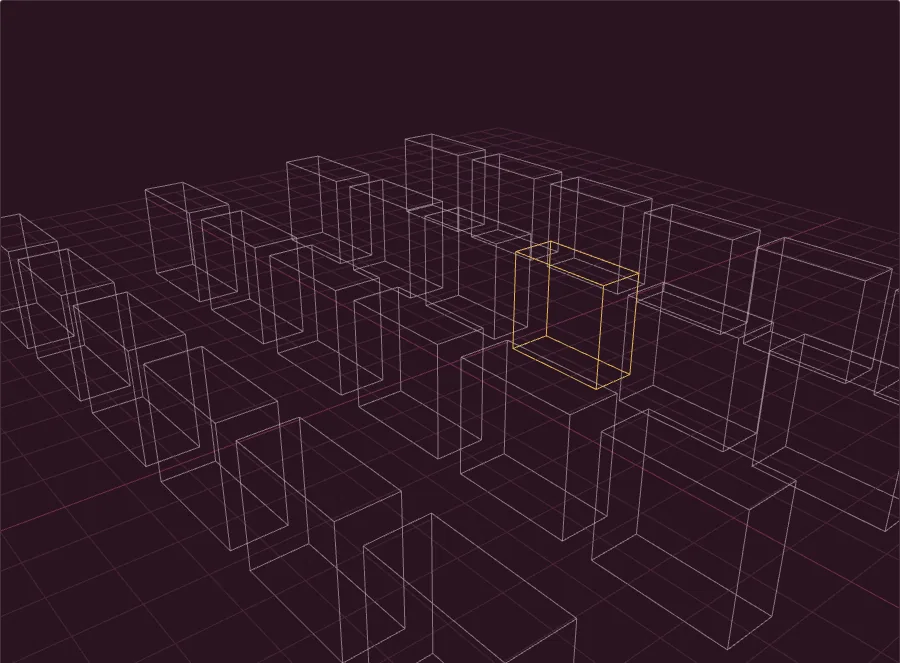
Drag to orbit · scroll to zoom — a live model, running in your browser
Eight locations. Two ways of knowing them.
- A-12-01-B1
- A-12-02-B1
- A-12-03-B1
- A-12-04-B1
- A-12-01-B2
- A-12-02-B2
- A-12-03-B2
- A-12-04-B2
Eight strings. No height, no depth, no distance between them — and nothing an algorithm can reason about physically.
The same eight in true X, Y, Z — with cubic capacity, physical constraints, and the real walk between them.
Millimetre-accurate · built with a tape measure, in hours
No AI can optimize space it can't see. Most platforms feed algorithms flat spreadsheets and call it intelligence — a list of bin codes with no sense of height, depth, or the physical walk between them.
The Dynamic Spatial Model gives the AI the one thing it was missing: the actual shape of the room.
A short, interactive demo of building the Dynamic Spatial Model yourself — not the full Spatialis OS platform.
- 3D Dynamic Spatial Model
- A live digital twin of your facility in true X, Y, Z space — exact coordinates, cubic capacity, and physical constraints for every bin, shelf, and aisle. Built by your own team with a tape measure, in hours.
- Digital Twin
- A digital twin is a live, continuously updated model of a physical asset. For a warehouse, that means the model isn't a one-time snapshot — it stays in sync with how the facility actually changes.
- Single-Touch Put-Away
- Incoming stock is routed straight to its optimal 3D bin location the moment it hits the dock — no re-slotting, no double-handling.
- Cubic Utilization
- The share of a facility's true volumetric capacity in active use. Industry average sits near 22–27%; Spatialis customers typically recover 10–25% more of it.
| Inventory Location Accuracy | 98–99.5% |
| Cubic Capacity Recovered | +10–25% |
Figures reflect Spatialis OS internal benchmarks and cited industry research on inventory location accuracy and warehouse cube utilization. Results vary by facility.
FAQ
Questions about the spatial model.
01What is a warehouse digital twin?
A warehouse digital twin is a live, continuously updated 3D model of a facility — every bin, shelf, rack, beam, and aisle mapped in true X, Y, Z space, instead of flat rows and bin codes in a spreadsheet. Spatialis OS calls its version the Dynamic Spatial Model; it's the foundation the rest of the platform — AI slotting, indoor navigation, fulfillment — runs on.
02Do we need CAD software or a land survey to build it?
No. The model is built by your own team with a tape measure and the Spatialis mobile app — no CAD software, no land surveys, no engineering fees. Most facilities have a working model in hours.
03How does the AI actually use the spatial model?
The slotting engine recalculates travel-cost-to-pick daily against the live 3D model and automatically pushes optimal putaway and re-slotting tasks — because it can see the real shape of the room, not just a list of bin codes. Customers typically recover 10–25% more of their facility's true cubic capacity as a result.
See the whole system: explore the full platform → or see the 12-week deployment timeline →